Español
English
Español
English
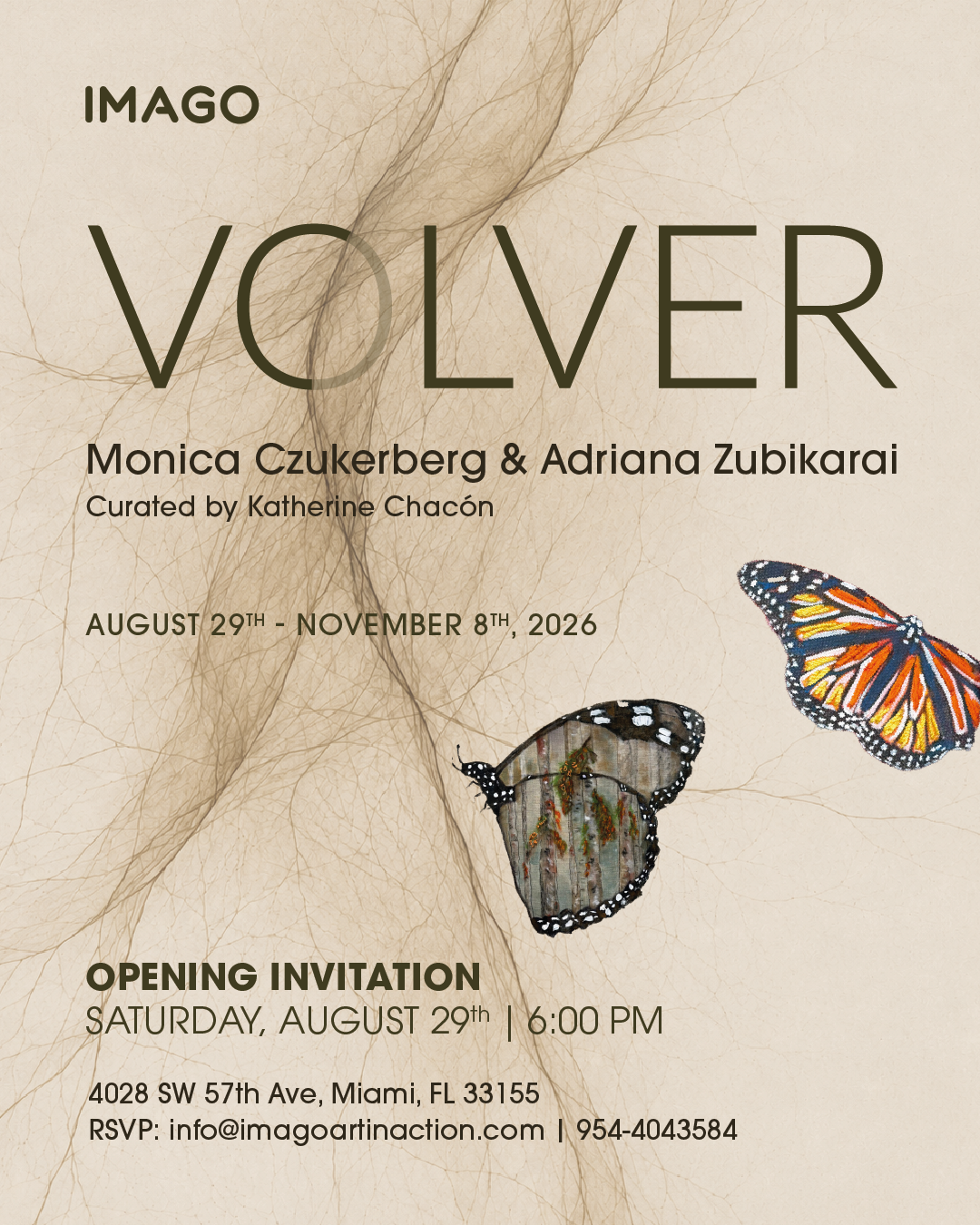
Title: VOLVER
Artists: Adriana Zubikarai & Monica Czukerberg
August 29 – November 8 / 2026
Opening reception: Saturday, August 29 / 2026, 6 pm
Imago Cultural Center is pleased to invite you to VOLVER, an exhibition that celebrates the encounter between art and nature through the work of Mexican artists Monica Czukerberg and Adriana Zubikarai. Curated by Katherine Chacón and inspired by the cycles of migration and return found in the natural world, the exhibition invites us to reflect on memory, the sense of belonging, and the invisible ties that connect us to our origins. An invitation to look, contemplate, and discover that, sometimes, VOLVER—to return—is also a way of continuing to transform ourselves.
What does volver—to return—mean? In the natural world, returning is far more than movement from one place to another. It is an ancient impulse, embedded in the living memory of countless species, guided by a quiet intelligence that carries them across oceans, skies, and lands. Each year, millions of birds, marine mammals, insects, and other migratory animals undertake journeys of astonishing precision, finding their way back to the places where life can renew itself. More than a biological phenomenon, return reveals a profound form of belonging. To return is to recognize a place—as origin, refuge, or destination—and to find one’s way back to it, making the journey itself an enduring affirmation of life’s continuity.
Together, the works presented in Volver remind us that migration and rootedness are not opposing experiences, but complementary movements through which life and culture continually renew their bond with the Earth. Perhaps it is in the act of returning—whether literal or imagined—that identity finds one of its most genuine forms of persistence.
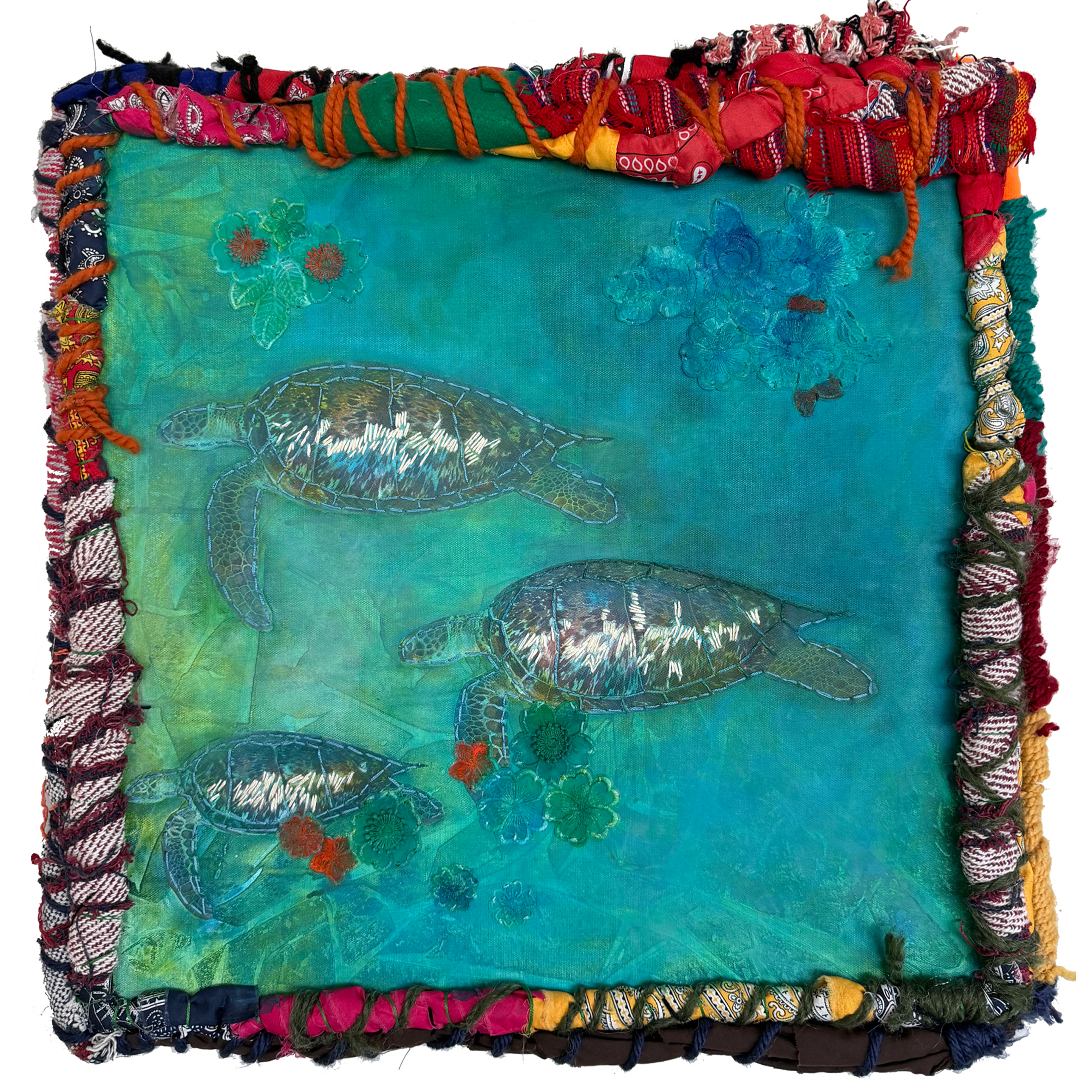
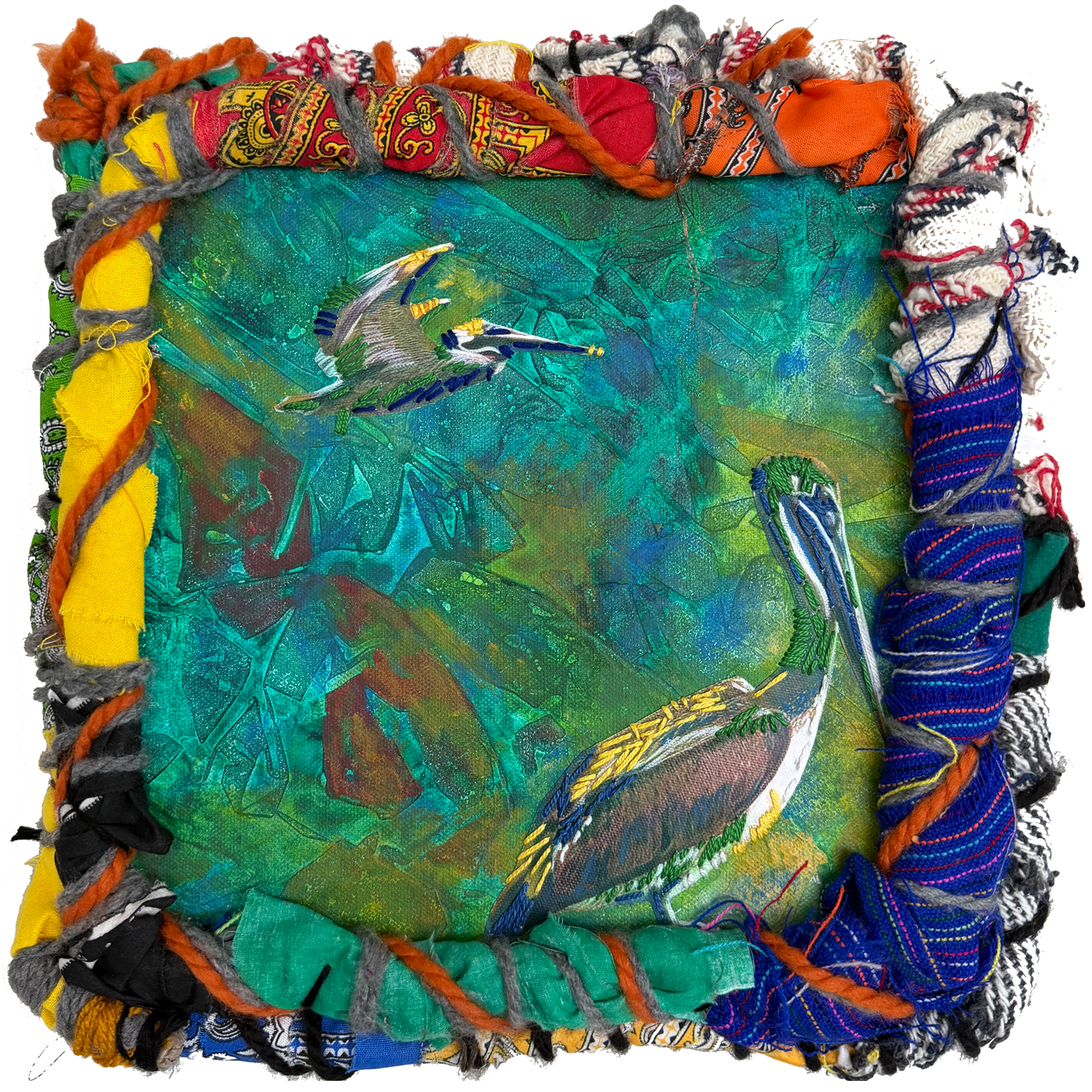
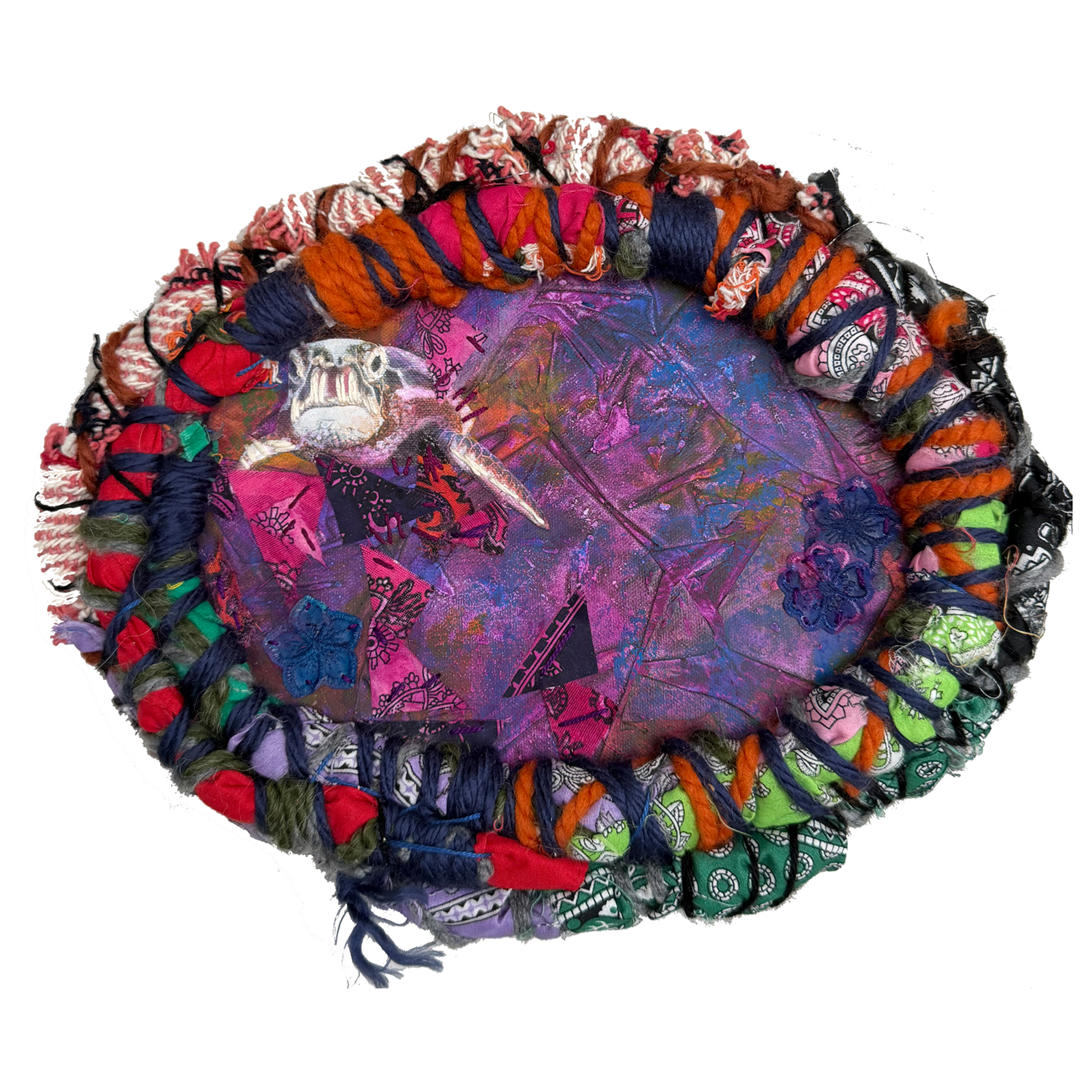
This exhibition brings together works by Monica Czukerberg (Mexico City, 1983) and Adriana Zubikarai (Mexico City, 1975), whose artistic practices examine migration and the enduring ties between living beings and the Earth. Each through a distinct visual language, the two artists turn to animal migration as a powerful metaphor for the persistence of what, even after being left behind, continues to inhabit both body and imagination.
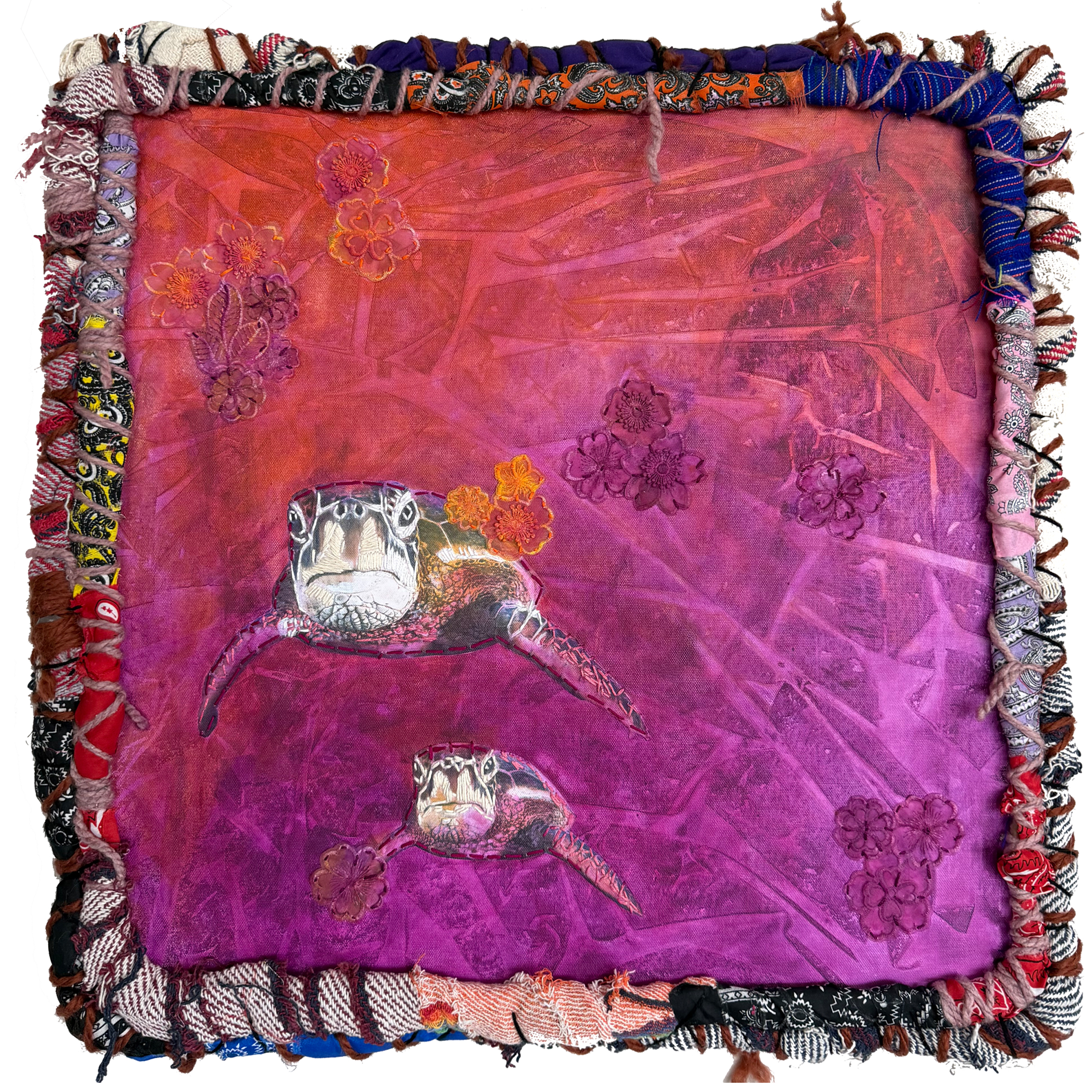
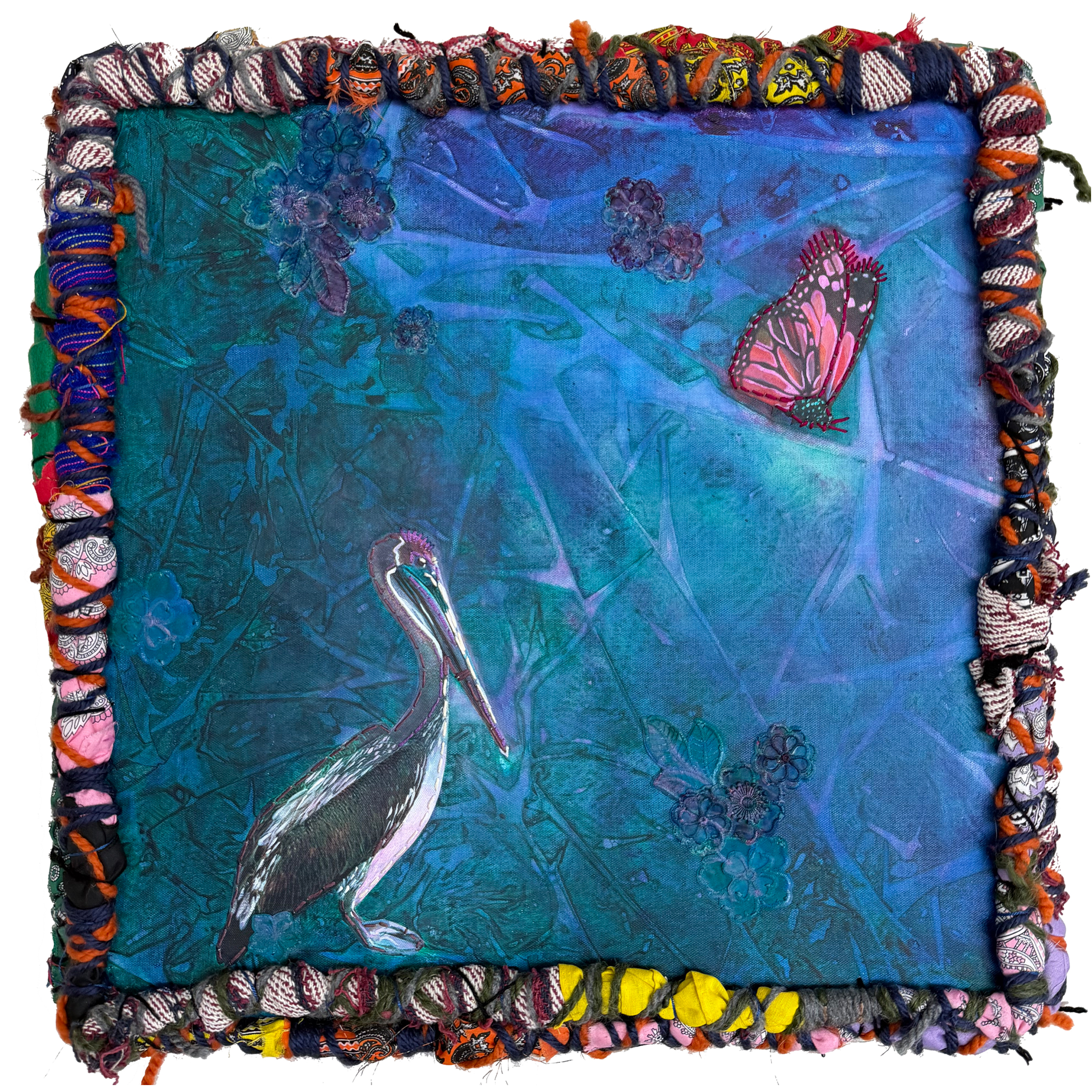
The migratory species that inhabit Monica Czukerberg‘s work—frigatebirds, terns, pelicans, sea turtles, and monarch butterflies—travel immense distances as they return to the Mexican coasts, mangroves, and forests where they breed and nest. These creatures seem to emerge from expansive fields of color in which references to water and vegetation remain deliberately open, suspended between abstraction and the natural world. Rather than evoke a literal geography, Czukerberg creates poetic environments in which figure and landscape dissolve into one another.
The migratory species that inhabit Monica Czukerberg‘s work—frigatebirds, terns, pelicans, sea turtles, and monarch butterflies—travel immense distances as they return to the Mexican coasts, mangroves, and forests where they breed and nest. These creatures seem to emerge from expansive fields of color in which references to water and vegetation remain deliberately open, suspended between abstraction and the natural world. Rather than evoke a literal geography, Czukerberg creates poetic environments in which figure and landscape dissolve into one another.
Textile occupies a central place in these works. Borders crafted from recycled fabrics, embroidery, traditional weaving, and reclaimed materials frame each composition. These fragments belong to an evolving textile project that Czukerberg has developed over many years as part of her ongoing exploration of Mexican craft traditions and their relationship to cultural memory.
For Czukerberg, origin extends beyond geography: it is a place of belonging that remains active even through displacement. To return is to keep alive the connection to something that, in one way or another, shapes who we are. Each return reaffirms a bond with one’s origins while reconstructing a map of memories that, layered through experience, ultimately become woven into one’s very being. Even the places we leave behind may continue to feel like our own. Memory will always find its way back, again and again.
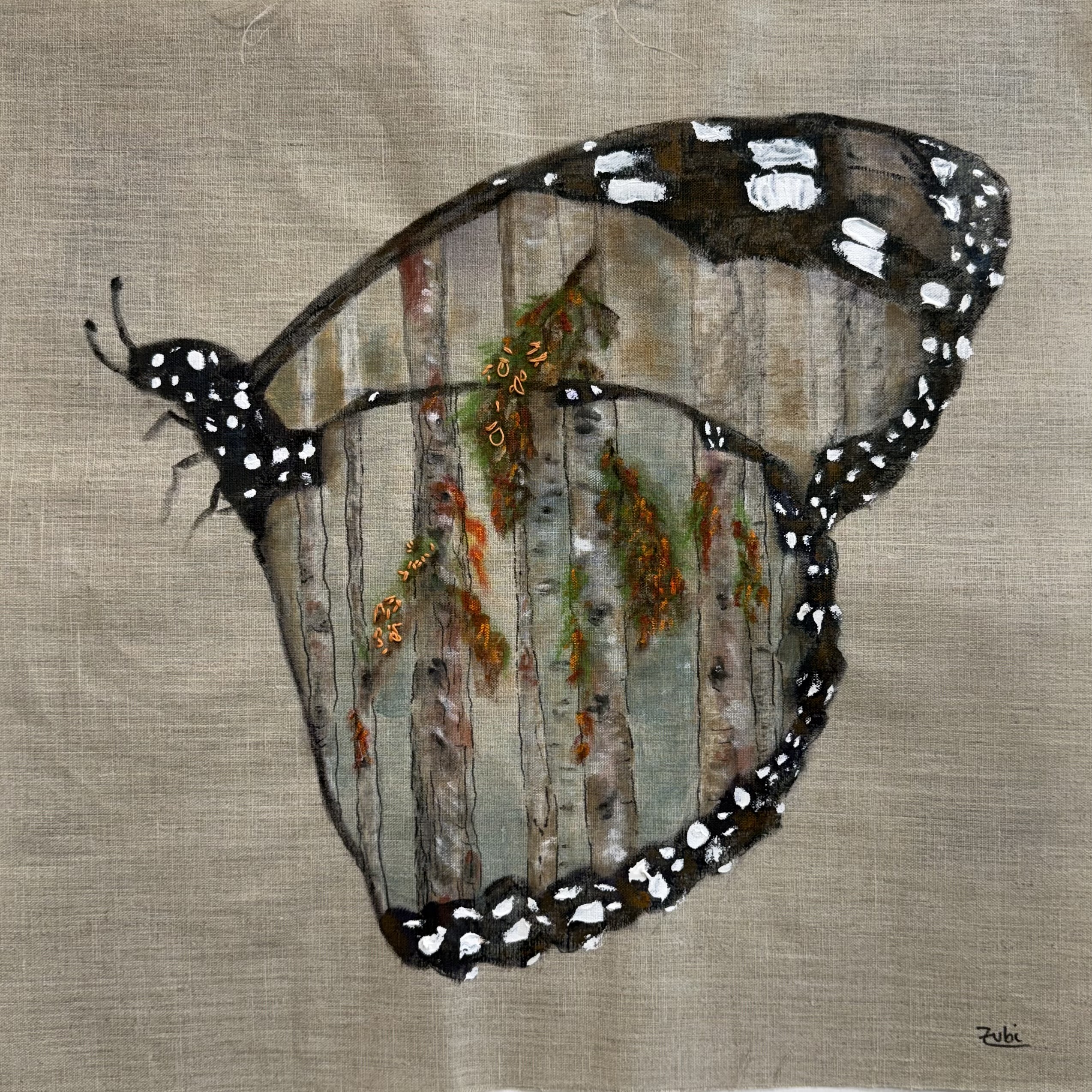
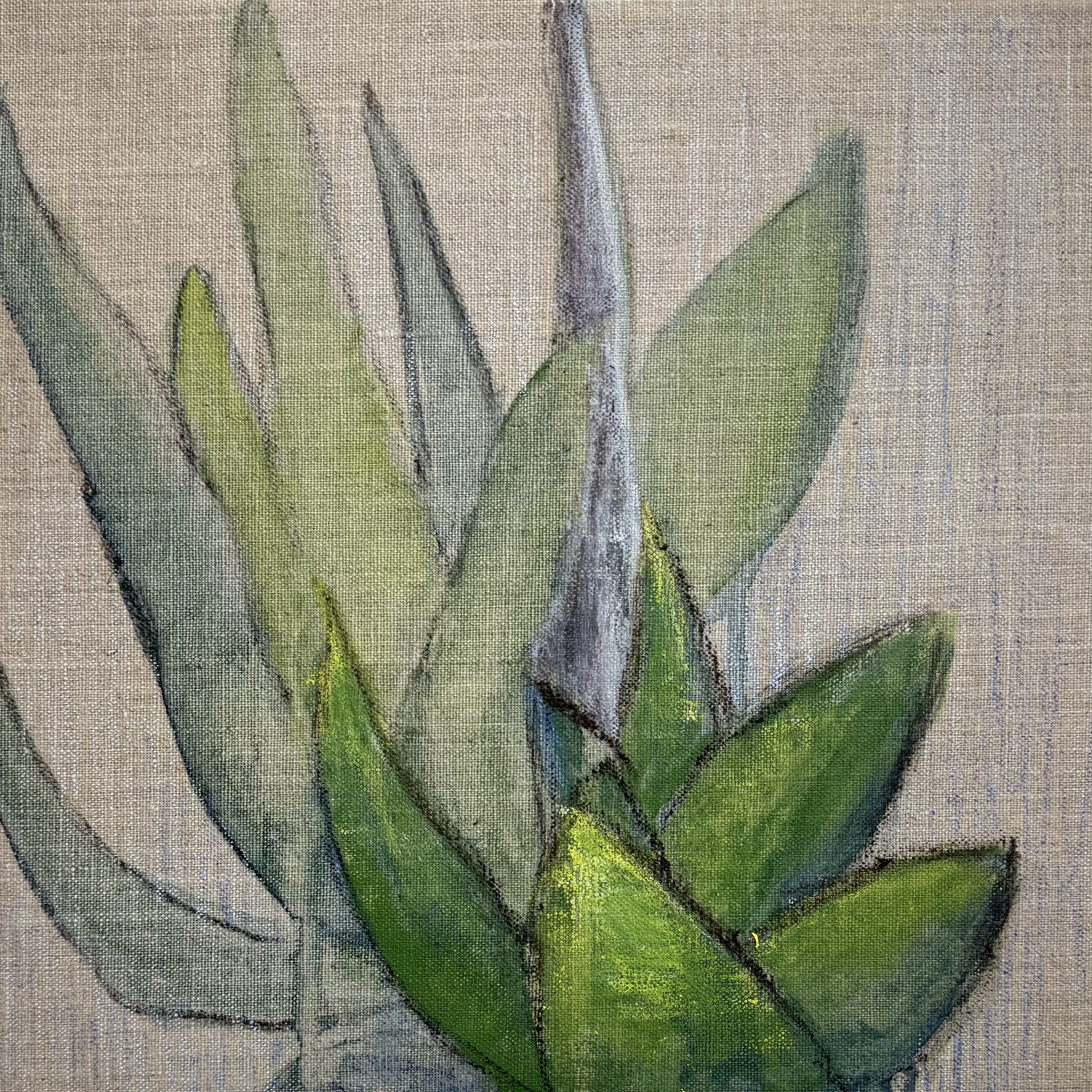
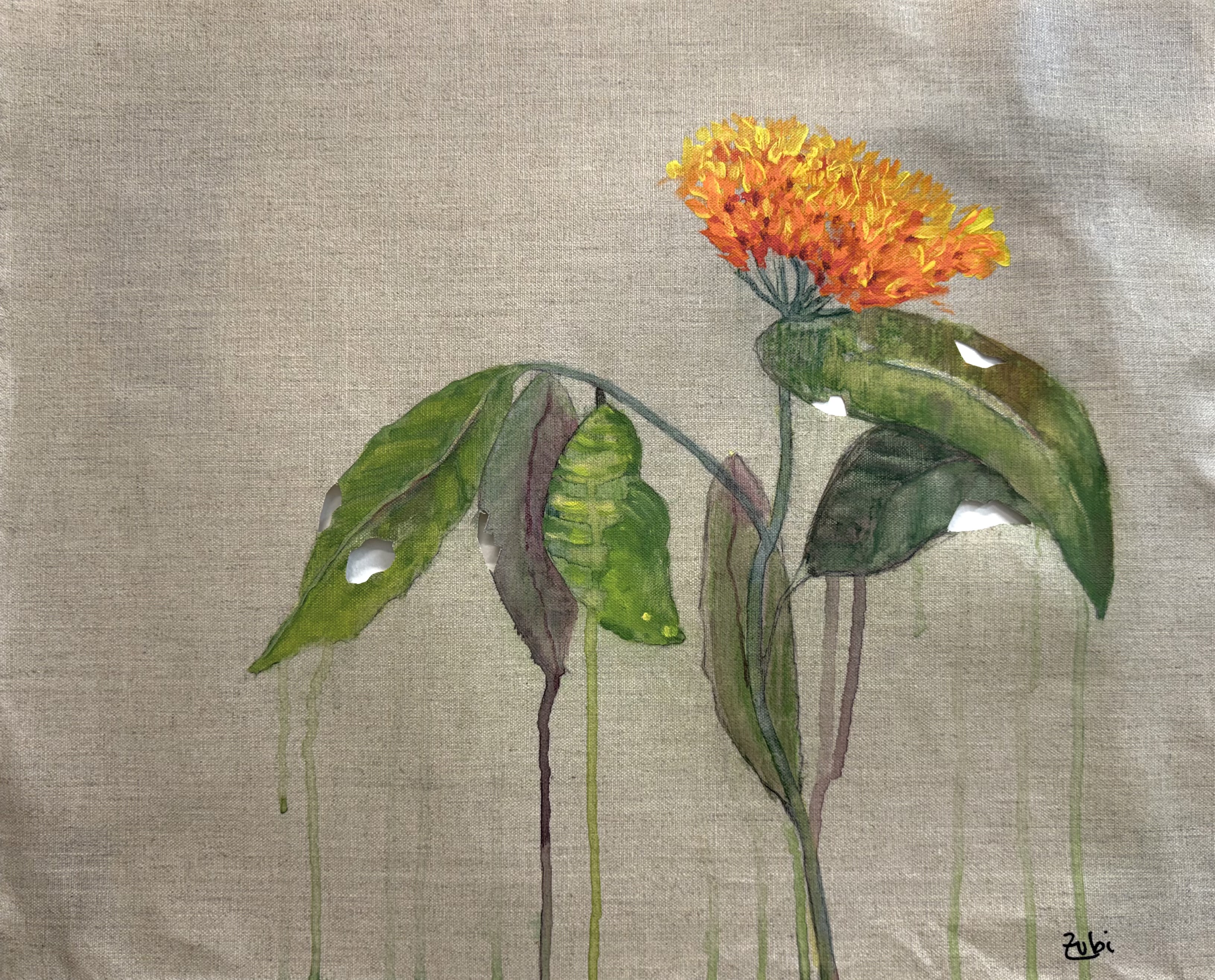
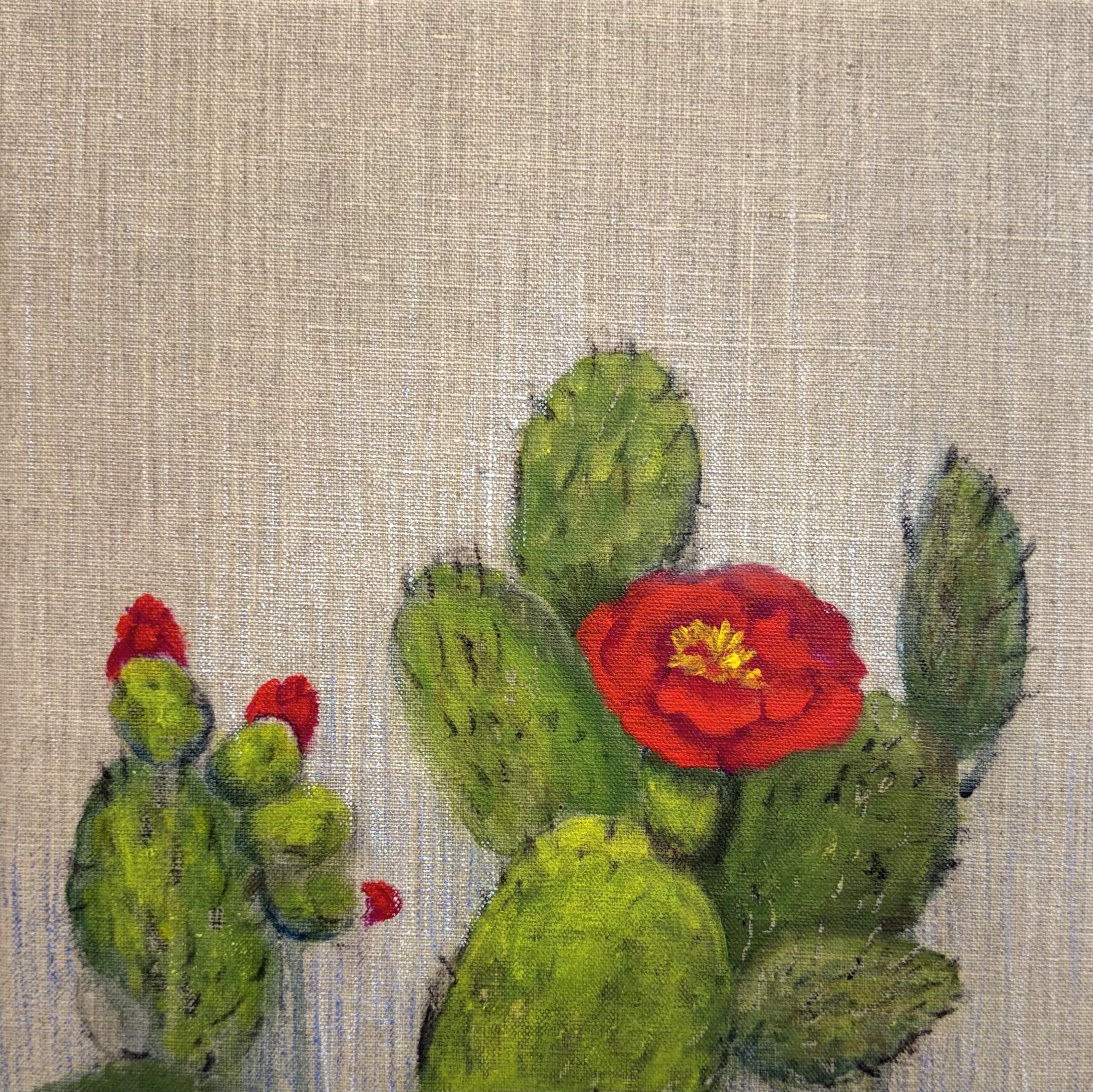
In Adriana Zubikarai’s work, the act of returning manifests itself paradoxically through absence. The traces left by humpback whales as they disappear beneath the ocean’s surface, the agave sustained through the pollinating visits of the lesser long-nosed bat, the perforations left by caterpillars on milkweed leaves, and the butterfly whose emergence marks the disappearance of the larva all reveal that every vital process unfolds through cycles of appearance and disappearance, presence and absence.
While rooted in close observation of the natural world, Zubikarai’s work extends well beyond illustration. Some compositions reduce drawing to its essentials, allowing color and impasto forms to emerge against barely intervened linen surfaces. Her landscapes possess an atmospheric quality: horizons dissolve, light seems suspended, and space itself becomes evocative. Working across mixed media, Zubikarai brings together craft traditions—including embroidery—with contemporary technologies such as augmented reality.
These works invite us to consider migration as part of an ongoing succession of transformations, in which absence becomes a necessary condition for new beginnings. Landscape and vegetation become active participants, bearing the traces of what has departed, what is yet to arrive, and what continues to transform beyond the visible.
Together, the works presented in Volver remind us that migration and rootedness are not opposing experiences, but complementary movements through which life and culture continually renew their bond with the Earth. Perhaps it is in the act of returning—whether literal or imagined—that identity finds one of its most genuine forms of persistence.
Katherine Chacón
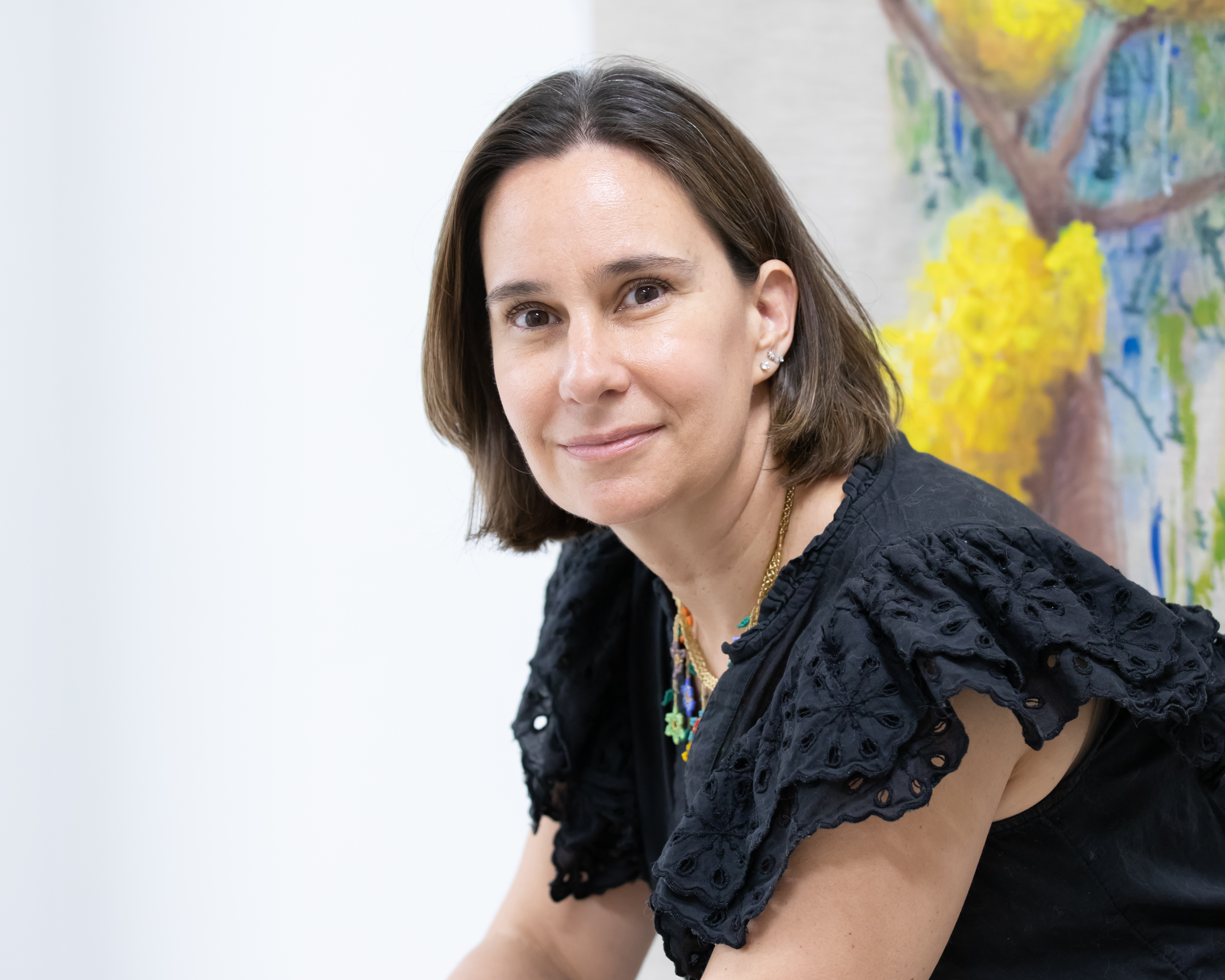
About the artists:
Adriana Zubikarai (Mexico City, 1975) is a visual artist, curator, educator, and children’s book author. She earned a B.A. in Economics from Universidad Iberoamericana in Mexico City (1993–1997) before pursuing studies in photography at the International Center of Photography (ICP) in New York, where she specialized in black-and-white photography, lighting, and general photographic studies. She later continued her artistic training in drawing and painting at the Leah Lopez Atelier and the New York Academy of Art (NYAA), where she attended professional development programs over more than a decade.
Her multidisciplinary practice encompasses painting, drawing, sculpture, photography, video, and fiber arts, reflecting an ongoing interest in the intersections between artistic experimentation, ecological awareness, and visual storytelling. Alongside her studio practice, she has worked as an educator, curator, and exhibition organizer, collaborating with institutions such as Miami International Fine Arts (MIFA), P71, and ROOM in Tribeca, while also publishing the children’s book Cosas, Cosas por Quisicosas.
Over the past two decades, Zubikarai has developed an active exhibition career that includes exhibitions in Mexico, the United States, and Japan. Her work has been presented at venues such as the International Center of Photography, Salmagundi Club, Bennington Center for the Arts, Hyanky Gallery in Osaka, Aqua Art Miami, and Miami International Fine Arts (MIFA), among many others. In 2026, she presented her first solo exhibition at MIFA, The Migration of the Self. Her work has also been featured in publications including Art Miami Magazine, which named her among its Female Artists to Watch in 2025.
Monica Czukerberg
(Mexico City, 1983) is an architect and visual artist. She studied Architecture at Anáhuac University (2002–2006) and furthered her training with courses in fashion, art history, drawing, and painting at Universidad Iberoamericana and the Centro de Diseño, Cine y Televisión in Mexico City, as well as at the Istituto di Moda Burgo in Milan.
She worked for three years at Grupo Elipse, an architecture firm in Mexico City, an experience that deepened her interest in space, materiality, and design—elements that continue to shape her artistic practice. Since then, she has built a steady career that includes six solo exhibitions—among them at Galería Óscar Román and Casa Nuestra (formerly the Old Senate of the Republic in Mexico City)—and around forty group shows in galleries, museums, universities, and cultural institutions in cities such as Cancún, Miami, New York, and Madrid.
For ten years she studied in the painting workshop of Eugenia Orozco and also served as a juror for a children’s painting competition organized by Karen Kayemet LeIsrael in Mexico City. In 2025, she earned her Master of Fine Arts (MFA) at Barry University in Miami, presenting a thesis exhibition that explored sustainability through the reuse of materials and sought to create a space where abstraction and nature could coexist.
In 2025, she presented the solo exhibition Mexican Flowers, Living Memory at Miami International Fine Arts (MIFA), further expanding her ongoing exploration of the relationships between nature, memory, and Mexican cultural identity.